Incident vs Problem: The Most Common ITSM Confusion
Published on September 24, 2026
Incident vs Problem: The Most Common ITSM Confusion
Among all ITIL concepts, the distinction between an incident and a problem is probably the one most frequently misunderstood. While the confusion may seem harmless, it often impacts support efficiency, service quality, and long-term operational stability.
What Is an Incident?
An incident is an unplanned interruption to an IT service or a reduction in its quality.
The primary goal of Incident Management is straightforward: restore normal service operation as quickly as possible, even when the root cause is not yet identified.
Examples of Incidents
- A business application stops responding.
- A user cannot access email services.
- A network printer becomes unavailable.
- A server unexpectedly crashes.
When an incident occurs, the priority is restoring service and minimizing business impact.
What Is a Problem?
A problem is the cause, or potential cause, of one or more incidents.
Problem Management focuses on identifying, analyzing, and eliminating root causes to prevent future incidents from occurring.
Examples of Problems
- A software defect repeatedly causes application crashes.
- An incorrect network configuration produces intermittent outages.
- A faulty hardware driver generates recurring blue screens.
Unlike Incident Management, the objective is not rapid restoration but permanent resolution.
A Practical Example
Imagine that a file server suddenly becomes unavailable.
The service outage itself is an incident. Users lose access to their documents, and support teams must restore service quickly.
After investigation, engineers discover that a memory leak in a third-party service gradually consumes system resources until the server crashes. The memory leak is the problem.
The incident is resolved when the server is restarted and users regain access. The problem is resolved when the software fix permanently removes the memory leak.
Why Is the Difference Important?
Without effective Problem Management, organizations may spend their time resolving the same incidents repeatedly.
Benefits of clearly separating incidents from problems include:
- Reduced recurring incidents.
- Improved service availability.
- Lower support costs.
- Higher user satisfaction.
- More efficient use of IT resources.
Common Mistakes
Assuming the Incident Is Fully Resolved Once Service Is Restored
Restoring service is critical, but it does not necessarily address the underlying cause.
Creating a Problem for Every Incident
Not every incident requires a root cause investigation. Problem Management should focus on major or recurring incidents.
Confusing a Workaround with a Resolution
Restarting a server or applying a temporary fix is often a workaround. A problem is only resolved when the root cause has been eliminated.
How the Two Practices Work Together
Incident Management and Problem Management are complementary:
- An incident is detected.
- Service is restored as quickly as possible.
- Similar incidents are analyzed.
- A problem record is created to identify the root cause.
- A permanent fix is implemented.
- Recurring incidents disappear.
Conclusion
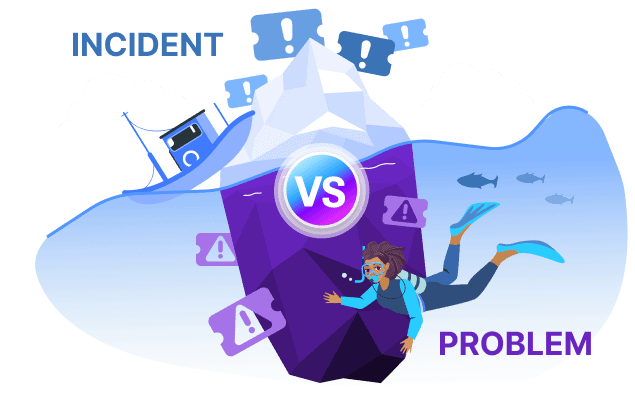
An incident and a problem are not two different words for the same concept. An incident is the visible disruption affecting users, while a problem is the underlying cause.
Understanding this distinction allows organizations to move beyond simply "fighting fires" and toward preventing future disruptions. It is one of the fundamental principles of a mature and effective ITSM practice.
To further develop your understanding of IT Service Management concepts, including Incident Management, Problem Management, and continual improvement practices, consider exploring the ITIL V5 Foundation certification path.