The 7 ITIL Guiding Principles Explained Simply
Published on November 5, 2026
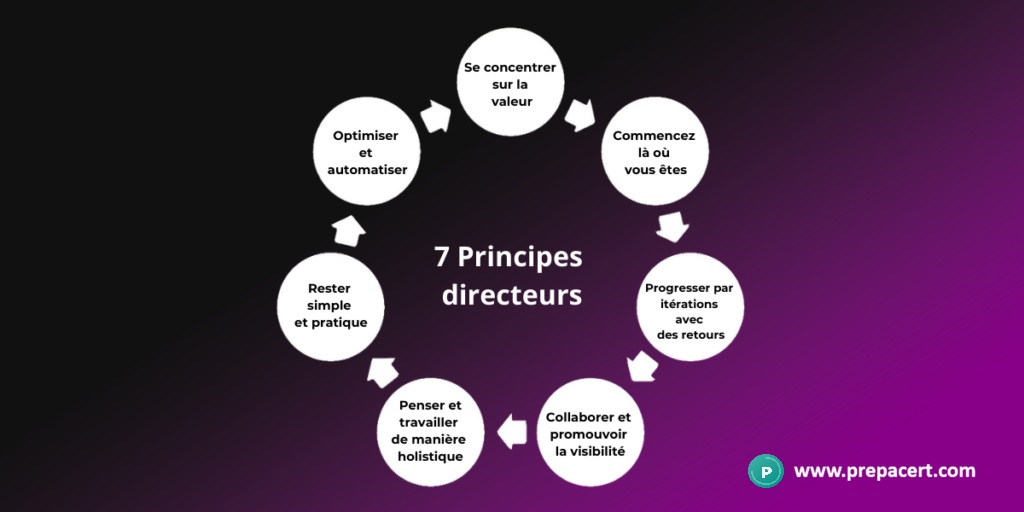
The 7 ITIL Guiding Principles Explained Simply
The guiding principles are among the most cross-cutting elements of ITIL: they don't apply to a single practice, but guide every decision, at every level of an organization. They're a core part of the Service Value System and a must-know topic on the ITIL V5 Foundation exam.
Why guiding principles?
Unlike rigid procedures, the guiding principles are universal recommendations, applicable regardless of context, organization, or type of project. They act as a compass for making good decisions, especially in new or unexpected situations.
Here are the seven principles you need to know.
1. Focus on value
Everything an organization does should, directly or indirectly, contribute to the value perceived by stakeholders — customers, users, sponsors.
Example: before building a new feature, asking "how does this actually create value for our users?" rather than building it just because it's technically possible.
2. Start where you are
There's rarely a need to rebuild everything from scratch. This principle encourages assessing what already exists — and what's already working — before deciding what to change.
Example: before replacing a support tool, precisely analyzing what's actually causing problems in the current tool rather than switching out of reflex.
3. Progress iteratively with feedback
Rather than aiming for a perfect solution from the start, it's better to move forward in small steps, gathering feedback at each iteration to adjust direction.
Example: rolling out a new feature to a pilot group of users before a full rollout, in order to fix issues that come up.
4. Collaborate and promote visibility
The best results come from involving the right stakeholders at the right time, and making work visible to build coordination and trust.
Example: making a project's progress visible to every team involved, rather than only communicating when something goes wrong.
5. Think and work holistically
No service or process works in isolation. This principle is a reminder to consider the whole system — people, processes, technology — to achieve consistent results.
Example: before changing a change management process, assessing its impact on incident management, security, and user experience.
6. Keep it simple and practical
If a process, rule, or procedure doesn't deliver clear value, it should be simplified or removed. Unnecessary complexity slows organizations down.
Example: removing a redundant approval step in a request process that no longer provides any real control value.
7. Optimize and automate
Before automating a task, you must first optimize it. Automating an inefficient process just reproduces its flaws faster.
Example: simplifying and clarifying a service request process before making it available through an automated self-service portal.
A key point: the principles work together
A common pitfall is treating each principle in isolation. In reality, when making a decision, several principles usually apply at the same time, with priorities that shift depending on context.
There's no fixed order of importance among the seven principles — their relevance always depends on the situation.
A concrete example
A company wants to improve its incident management process, which it considers too slow.
- It starts by analyzing the existing process → Start where you are.
- It involves support staff, technical teams, and a few key users → Collaborate and promote visibility.
- It identifies the real goal: reducing the downtime perceived by users → Focus on value.
- It tests a new process with a single team before rolling it out more broadly → Progress iteratively with feedback.
- It checks the impact on problem management and change management → Think and work holistically.
- It simplifies the qualification steps before automating certain responses → Keep it simple and practical, then Optimize and automate.
All seven principles were used naturally, with no imposed order, depending on what each step required.
Common exam pitfalls
Assuming there's a fixed order of priority
The seven principles have no predefined hierarchy — their relative importance depends on context.
Confusing "optimize" with "automate"
Automation comes after optimization, never before. Automating a non-optimized process only amplifies its flaws.
Believing only one principle applies at a time
In reality, as on the exam, a given situation very often involves several principles at once.
Conclusion
The seven ITIL guiding principles — focus on value, start where you are, progress iteratively with feedback, collaborate and promote visibility, think and work holistically, keep it simple and practical, optimize and automate — form a foundation of common sense applicable to any decision, regardless of context or organization.
Knowing them by heart isn't enough: you also need to be able to recognize them in a scenario, which is what most exam questions on this topic actually test.
To practice on this topic and the full syllabus, check out our ITIL V5 Foundation exam prep.