What Is the Service Value Chain?
Published on October 2, 2026
What Is the Service Value Chain?
Among the core concepts of ITIL's Service Value System (SVS), the Service Value Chain is probably the one that confuses ITIL V5 Foundation candidates the most. Despite what the name might suggest, it isn't a linear step-by-step process — it's a flexible operating model.
What exactly is the Service Value Chain?
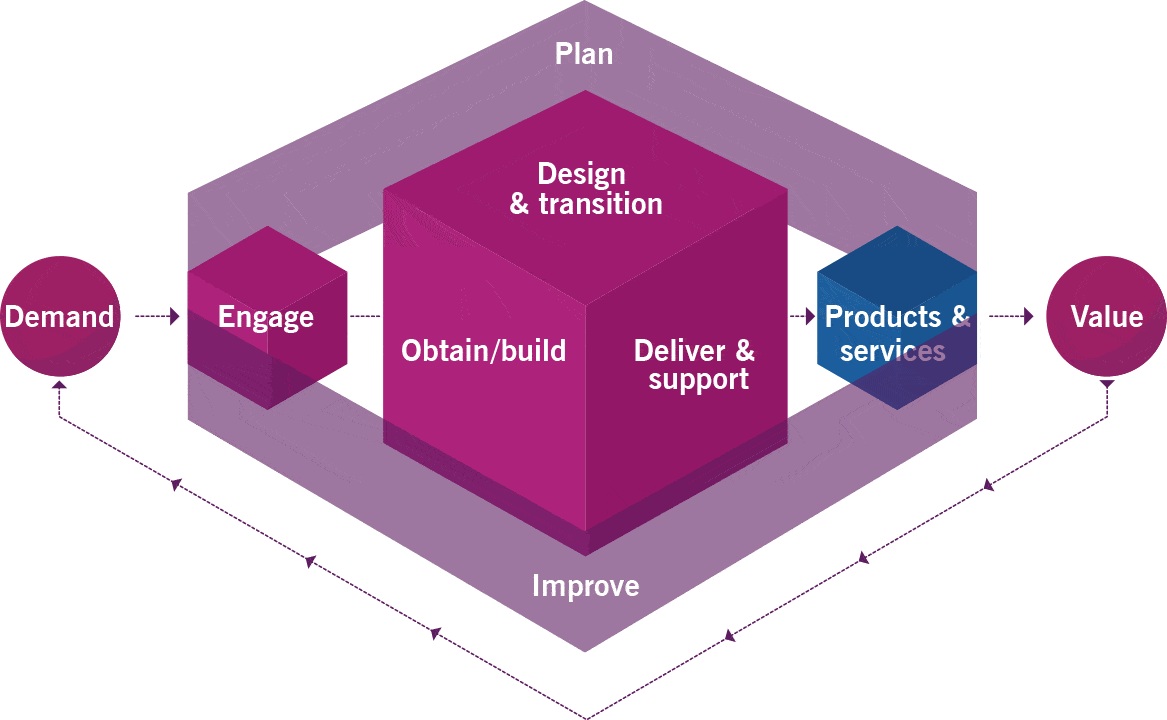
The Service Value Chain sits at the center of the ITIL Service Value System. It describes a set of six activities that any organization can combine, in any order, to turn demand into value-creating products and services.
Its purpose is to give a common structure to every activity that contributes, directly or indirectly, to value creation — whether that means building a new feature, resolving an incident, or improving an existing process.
The 6 activities of the Service Value Chain
Plan
Ensures a shared understanding of the vision, current status, and direction of improvement across the organization. This is where priorities and improvement strategies are defined.
Improve
Ensures continual improvement of products, services, and practices across every level of the organization.
Engage
Provides a good understanding of stakeholder needs (customers, users, suppliers, partners) and ensures transparency, engagement, and good relationships with them.
Design & Transition
Ensures that products and services continually meet stakeholder expectations for quality, cost, and time to market.
Obtain/Build
Ensures that service components are available where and when they are needed, and meet agreed specifications — whether built in-house or acquired from external suppliers.
Deliver & Support
Ensures that services are delivered and supported according to agreed specifications and stakeholder expectations.
A concrete example
Imagine a company wants to introduce a self-service password reset feature after noticing a high volume of support tickets.
- Plan — the team identifies this improvement as a priority, aligned with the goal of reducing support workload.
- Engage — user needs and security constraints are gathered from business and security teams.
- Design & Transition — the solution is designed, tested, and scheduled for deployment.
- Obtain/Build — the feature is either built in-house or acquired through a third-party tool.
- Deliver & Support — the feature goes live, and support staff are trained to assist users.
- Improve — after a few weeks, user feedback and usage statistics are used to refine and improve the feature.
These six activities weren't followed in a fixed order mandated by a standard — they were combined based on the specific needs of this use case.
Why this flexibility matters
This is the single most important point to remember for the exam: the six activities do not form a mandatory sequence. Any activity can trigger any other activity, in any order, depending on the situation.
This specific path through the activities, tailored to a given scenario (responding to an incident, launching a new offering, handling a change request...), has a precise name in ITIL: a value stream. The Service Value Chain provides the building blocks; a value stream is how those blocks are assembled for a particular use case.
Common exam pitfalls
Treating the Service Value Chain as a linear process
This is the most common mistake. There is no mandatory order between Plan, Improve, Engage, Design & Transition, Obtain/Build, and Deliver & Support.
Confusing "value chain" with "value stream"
The Service Value Chain is the generic model with six activities. A value stream is a specific combination of those activities, tailored to a particular scenario.
Overlooking the central role of governance
Governance is not an activity of the chain itself, but it directs how the chain operates within the Service Value System — a point that's sometimes a source of confusion between the SVC and the SVS.
Conclusion
The Service Value Chain is a deliberately flexible operating model, not a procedure to execute in a fixed order.
Remembering its six activities and understanding that they can be freely combined into value streams is one of the keys to answering related questions correctly on the ITIL V5 Foundation exam.
To go further with this concept and the full Service Value System, check out our ITIL V5 Foundation exam prep.